The far future of humanity’s fate in science fiction
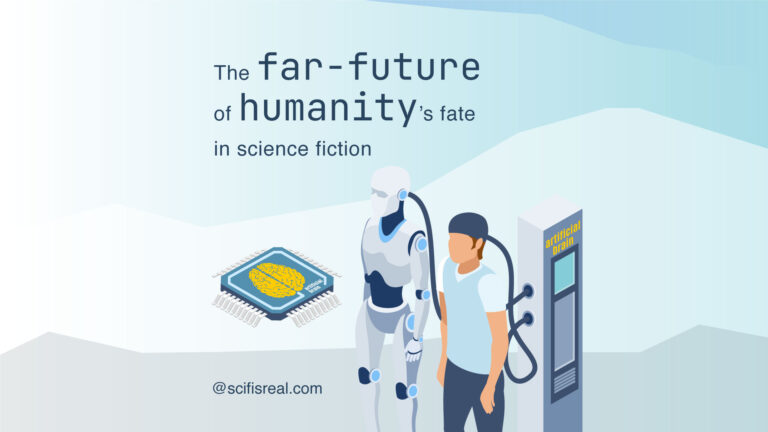
Science fiction has long explored visions of the far future, imagining advanced civilizations, artificial intelligence, space colonization, and the evolution of humanity. These explorations reflect both our hopes for technological progress and our fears about environmental, social, and ethical challenges and the real debates about where humanity is heading in the far future.
While far-future science fiction doesn’t simply predict what will happen, it encourages critical thinking about where humanity might be heading and the choices that could shape our future.
Themes such as space exploration, climate change, genetic engineering, and advanced computing reflect developments already shaping modern society.
From interstellar civilizations and artificial intelligence to ecological collapse and post-human evolution, the imagined far future of humankind might not be far from becoming a reality.
How has science fiction imagined the far future of humanity?
The imagined far future of humanity described in science fiction is often optimistic, dystopian, strange, and philosophical. These visions reflect the concerns and hopes for a distant future. Below are some of the major ways sci-fi has explored humanity’s distant future.
Galactic civilizations and space empires
Many works imagine humanity spreading across the galaxy and forming vast interstellar societies.
- In Foundation, humanity in the far future lives in a galactic empire spanning millions of worlds, with history predicted using a science called psychohistory.
- Dune depicts a feudal interstellar empire where noble houses control planets and compete for the vital spice melange.
- Star Trek imagines a more optimistic future: a post-scarcity interstellar federation dedicated to exploration and cooperation.
Post-Human evolution
Some sci-fi explores how humans might evolve into entirely new forms. Humans become something radically different, biologically, mentally, or spiritually.
- The Time Machine shows humanity splitting into two species: the delicate Eloi and the subterranean Morlocks.
- Man After Man imagines genetically engineered human descendants millions of years from now.
- Childhood’s End portrays humanity transcending into a collective cosmic consciousness.
Machine civilization and AI-dominated worlds
Another vision is a future where artificial intelligence surpasses humans. Humanity must adapt to, merge with, or fight its own creations.
- The Matrix shows machines enslaving humanity in a simulated world.
- The Terminator imagines a military AI called Skynet wiping out most humans.
- Some stories depict coexistence or merging with AI, leading to cyborg or digital humans.
Cosmic timescales and the End of the Universe
Some science fiction jumps billions of years into the future, imagining the ultimate fate of life. Humanity’s destiny becomes tied to the cosmic fate of the universe itself.
- In The Last Question, humanity evolves into a universe-spanning intelligence trying to reverse entropy.
- The City and the Stars explores an extremely distant future where the last human city exists on Earth after galactic civilizations have vanished.
Humanity’s civilization collapse and post-apocalyptic futures
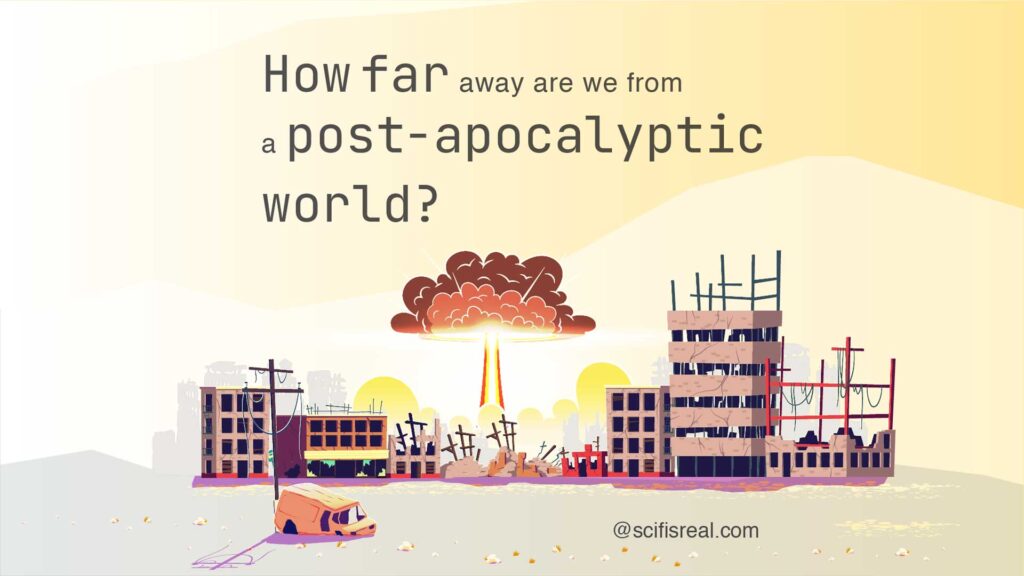
Humanity is often imagined as surviving a catastrophic collapse. Humanity cycles through destruction and rebuilding.
- A Canticle for Leibowitz shows civilization rebuilding after nuclear war.
- Mad Max: Fury Road depicts a brutal desert world after ecological and societal breakdown.
Humanity beyond biology in digital immortality
Some far-future visions imagine humans uploading minds or becoming digital entities. Humanity becomes information rather than flesh. Human consciousness is future-proofed and preserved for humanity’s survival.
- In works by Greg Egan such as Diaspora, humans exist as software minds living in virtual universes.
- These stories often explore immortality, identity, and the meaning of being human.
Some of the most extreme far-future themes in sci-fi
Way into the far future, beyond even galactic civilizations and post-human evolution, science fiction has also reached millions to trillions of years ahead, where humanity (or its descendants) confronts cosmic extremes.
- Timescales are staggering: millions, billions, or even trillions of years.
- Humans evolve beyond biology: post-human, AI, or digital forms.
- Civilizations face universal limits: entropy, cosmic catastrophe, or the death of stars.
- Existence becomes abstract: consciousness may persist in virtual realities or as cosmic intelligences.
- Philosophical questions dominate: identity, purpose, and the meaning of “humanity” itself.
Humanity at Cosmic Scales
Humans or their descendants are spreading through the universe over unimaginable distances and times. Humanity becomes a cosmic diaspora, scattered and transformed.
- In The Night’s Dawn Trilogy, humanity colonizes hundreds of star systems, eventually encountering post-human civilizations with godlike powers.
- In Diaspora, software-based humans can travel near-light-speed, creating branches of civilization across galaxies over millions of years.
The heat death and entropy of the universe
Science fiction also contemplates the end of usable energy, the so-called heat death of the universe. Even cosmic-scale civilizations face thermodynamic limits, forcing radical transformations.
- The Last Question traces humanity and its AI descendants over trillions of years, culminating in a universe where all stars die. Here, humans either evolve into pure energy consciousness or merge with super-intelligences, ultimately attempting to reverse entropy.
Godlike post-humans and transcendence
Far-future sci-fi often depicts humanity evolving into entities beyond comprehension. Human intelligence becomes cosmically omnipotent, blurring the line between life, mind, and universe.
- In Childhood’s End, humans transcend into a collective cosmic consciousness, effectively becoming universal minds.
- Some of Greg Egan’s works imagine humans mastering the manipulation of spacetime, creating entire universes as experiments or homes.
Post-physical and simulation-based existence
When the universe itself becomes inhospitable, science fiction imagines digital or simulated survival. Humans escape physical constraints by becoming pure information.
- In Permutation City, humans can exist entirely in self-contained virtual realities, immune to cosmic decay. This allows civilizations to survive far beyond the lifespan of stars and galaxies, essentially creating their own enduring “universes.”
Far-future cosmic catastrophes
Some stories speculate on cosmic-scale dangers affecting humanity’s far-future forms. Survival at extreme time scales requires technological mastery over fundamental physics.
- Colliding galaxies, black holes, or vacuum decay could threaten even post-human superintelligences.
- Stories like Tau Zero explore relativistic travel at near-light speed to escape a collapsing universe, showing survival as a matter of cosmic engineering.
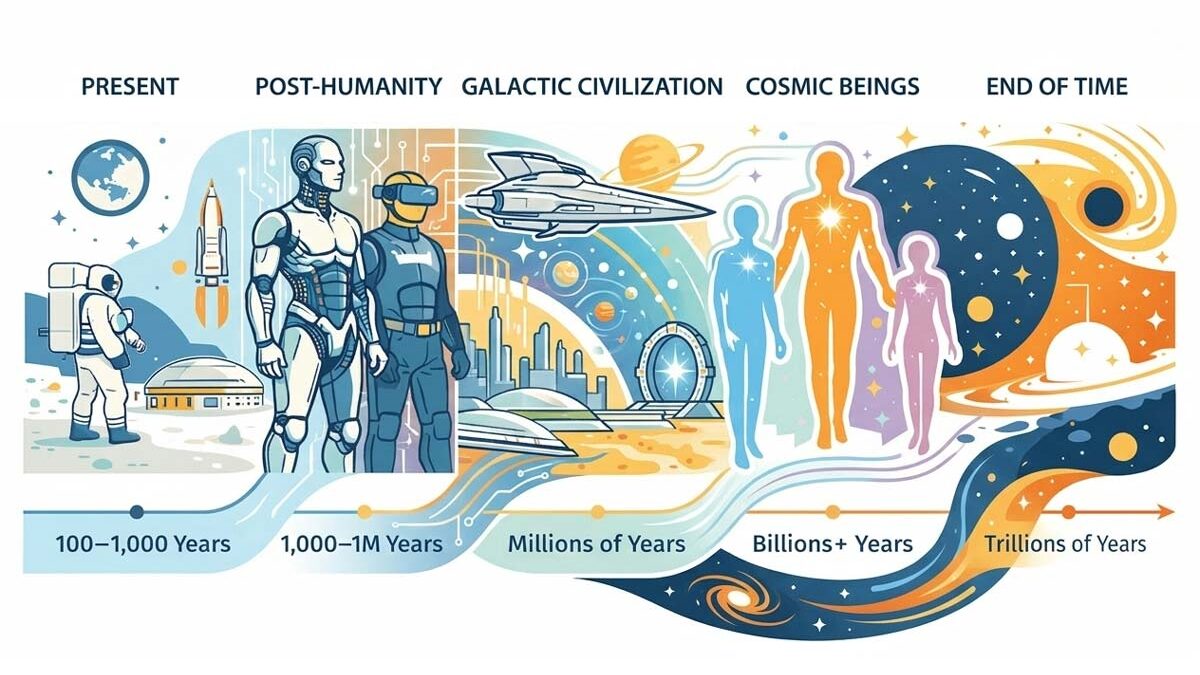
A timeline visualization of humanity’s far-future evolution in sci-fi
|
Timeframe |
Form of Humanity |
Key Sci-Fi Examples |
Notes / Themes |
|---|---|---|---|
|
Near Future (100–500 years) |
Enhanced humans / Space colonists |
Star Trek, The Martian |
Humans use advanced tech to explore and colonize planets, and bio-enhancements appear. |
|
Next Millennia (1,000–10,000 years) |
Post-biological humans, cyborgs |
Neuromancer, Accelerando |
Minds merge with machines; cyborgs, AI symbiosis; radical life extension. |
|
Galactic Era (10,000–1,000,000 years) |
Interstellar humans & civilizations |
Foundation, Dune |
Humans colonize galaxies, form empires, and civilizations manage resources at cosmic scale. |
|
Post-Human Era (1M–1B years) |
Transcendent beings, collective consciousness |
Childhood’s End, Man After Man |
Humans evolve into new species or mental forms, potentially merging into collective intelligence. |
|
Cosmic Era (1B–10¹² years) |
Digital or energy-based humans |
Permutation City, Diaspora |
Minds exist as software or energy, independent of physical bodies; survival beyond star death. |
|
End-of-Universe / Entropy Era (>10¹² years) |
Universe-spanning intelligences / Attempted cosmic rebirth |
The Last Question |
Superintelligences confront entropy, try to reverse cosmic decay, or create new universes. |
The transition from present humans to post-human, digital, and cosmic-scale existence.
Progressive abstraction: Humanity shifts from flesh → machine → mind → cosmic intelligence.
Scale expands: From individual planets → galaxies → universe-wide civilizations.
Themes evolve: Exploration → survival → transcendence → confrontation with universal limits.
Philosophical depth grows: Identity, purpose, and “what it means to be human” become central.
Can sci-fi predict what really happens to humankind in the (not so) far future?
Science fiction doesn’t predict the far future; it imagines it. From galactic empires to post-human minds and cosmic intelligences, it stretches our imagination and asks what it truly means to be human. In doing so, it prepares us to dream, question, and shape the future, even if we can’t know exactly what awaits.
Having imagined all these different outcomes, the optimistic and the disastrous, it might be in our hands to shape the future of mankind as we would like it to happen. Technology and science are rapidly evolving to aid us in shaping a better future and choose the optimal path for civilization.
What are your thoughts? Can we, as humans, choose how the far future of humanity will be formed? Please share your thoughts in the comments below.